
TDCJ Releases After Andrews County
An Andrews County defendant sentenced to state prison may leave the Andrews County Jail for TDCJ intake. The county’s booking may close, but that movement is a transfer. It does not establish a return to the community. The county transfer entry, felony judgment, and TDCJ intake record trace the person from local to state custody.
Later state outcomes include parole, mandatory supervision, discharge, or another transfer. Parole and mandatory supervision place a person outside prison under TDCJ legal custody and conditions. Discharge is the stronger term for completion of the sentence or supervision shown by the record. The Texas Board of Pardons and Paroles decides matters within its authority, while TDCJ’s Parole Division supervises released people.
| Event | Custody meaning | Record source |
|---|---|---|
| Andrews transfer to TDCJ | State custody continues | Sheriff transfer entry and TDCJ intake |
| Parole | Physical release under supervision | Board action, TDCJ certificate, Parole Division |
| Mandatory supervision | Statutory supervised release if applicable | TDCJ and Board records |
| Discharge | Sentence or supervision completion | TDCJ discharge record |
Search TDCJ Andrews County Records
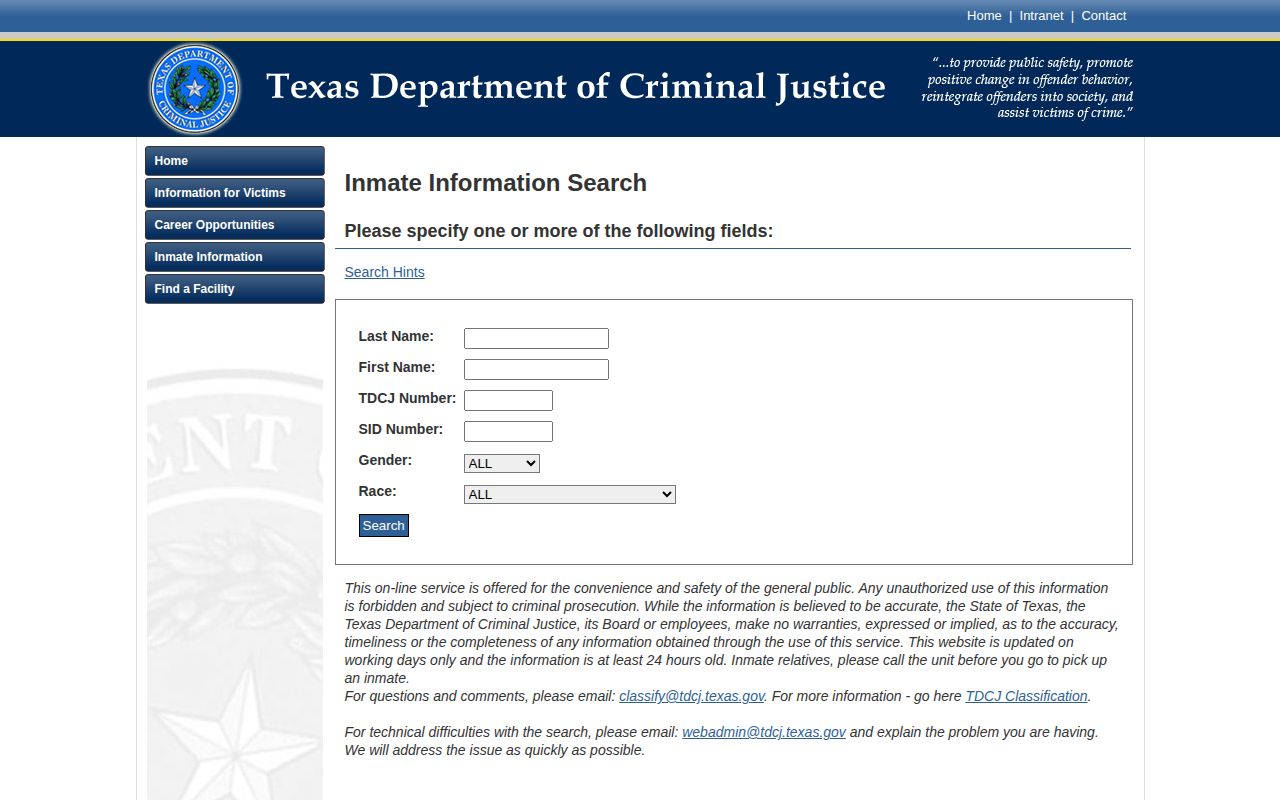
Open the official TDCJ inmate search. Use a TDCJ number or SID number when known because identifiers reduce false matches. Otherwise search with the name and other offered fields. Compare the county of conviction, offense, sentence begin date, and identifying data before relying on the result.
- Confirm that the Andrews County jail event was a transfer to TDCJ.
- Enter the TDCJ or SID number, or use the permitted name fields.
- Open the matching record and compare Andrews as the conviction county when applicable.
- Read current facility, projected release, maximum sentence, and parole eligibility as distinct fields.
- For a missing former prisoner, use TDCJ phone, email, or public-information channels.
- Request an actual release certificate or discharge record when historical proof is needed.
TDCJ’s web search is mainly an active-system locator, not a complete archive of every former prisoner. A blank result can require telephone or written research. The offender-information hub lists 936-295-6371 and 800-535-0283 for general inmate information and directs written requests through agency channels.
The statewide search fields are visible in the official capture below.
TDCJ Andrews Release Date Meanings
Projected Release Date is an estimate calculated from the sentence and applicable rules. Maximum Sentence Date is a separate endpoint. Parole Eligibility Date is the first date on which consideration may occur. None promises physical release. A new judgment, detainer, disciplinary credit change, Board action, or correction can alter the result.
Texas has no universal rule that all prisoners serve 85 percent. Government Code Section 508.145 has offense- and sentence-specific eligibility provisions. Chapter 498 governs good-conduct time and states that it is a privilege that affects eligibility where the law permits, not a rewrite of the judicial sentence. Mandatory supervision has exclusions and review rules under Sections 508.147 through 508.149.
A favorable Board vote still may require certificate audit, programming, residence approval, detainer review, or other processing. Common FI codes can authorize release when eligible, set a future period, or require a program. A vote code alone is not an actual release timestamp.
Confirm TDCJ Andrews Releases
After a favorable vote, Classification and Records audits the release certificate and legal data. TDCJ materials describe a common audit estimate of about 14 to 21 business days. Certain program-contingent cases may take roughly four to six weeks after successful completion under the circumstances the agency describes. These ranges are not guarantees for a named person.
The parole-review status line before a vote is 844-512-0461. After a favorable vote, release-processing status is available at 512-406-5202. The caller generally needs the TDCJ or SID number or exact date of birth. Use the number tied to the stage. A review answer, processing answer, release certificate, and supervision assignment each establish a different fact.
For historical proof, ask TDCJ for admission date, release date, release type, certificate, discharge date, and supervising office or status. The formal Texas Public Information Act route is available from the TDCJ information-request page. Lawful redactions may apply.
Andrews County Parole Destination
An Andrews County resident released from TDCJ on parole or mandatory supervision is assigned through the Monahans District Parole Office. That office is at 401 S Allen Avenue in Monahans, telephone 432-943-7254. It is a field office, not a detention facility. TDCJ’s county assignment list and Region V directory document the route.
Monahans DPO differs from Andrews County CSCD. CSCD handles court-ordered probation, pretrial intervention, and bond supervision. Monahans handles state parole and mandatory supervision after prison. A probation record does not prove TDCJ release, and a DPO assignment does not prove final discharge.
The Monahans District Parole Office record page explains how to verify that post-release assignment. Pair office confirmation with TDCJ release data rather than asking field staff to recreate the prison record.
TDCJ Network Contact and Scope
No TDCJ prison or state jail was identified as physically located in Andrews County during the official-source sweep. This page therefore represents the statewide network serving an Andrews case after transfer, not a local building. The current facility shown in the TDCJ result controls institutional contact.
Statewide online and telephone service
936-295-6371 or 800-535-0283
Email channel: pia@tdcj.texas.gov
Official inmate information
A written email request should include the full name and seven-digit TDCJ number. If that number is unknown, TDCJ requests exact date of birth or approximate age and county of conviction. The agency lists current and prior incarceration, current offense, county and court, location, and projected release among available information. It does not supply photographs through that email route.
Andrews County Transfer Proof
When the sheriff says a person was “released to TDCJ,” preserve the county booking number and request the destination or receiving agency. Match that entry to the District Clerk judgment and TDCJ record. The three records answer why local custody ended, where state custody began, and what sentence controls.
If TDCJ returns no result, do not assume community release. Check spelling and identifiers, call offender information, and request the county transfer documents. The person may have moved to another county, federal custody, or immigration custody instead. The Andrews County release-record process helps separate those networks.
The permanent county jail register can preserve the Andrews booking summary even when the web portal no longer shows it. For the state phase, ask TDCJ for the existing admission, location, release, and discharge material. Retention does not make every detail public, but it helps identify the right record series instead of treating a negative web result as proof.
Texas IVSS-Counties may alert on the earlier county event, while TDCJ Victim Services covers state correctional notification. These services have different feeds. After a transfer, move the notification request to the state system and keep the county booking number so the two events can be reconciled.
A TDCJ search result should also be checked against the county of conviction and the filed sentence. Similar names can produce false matches, and a state identifier is much stronger than a name alone. When the offense, sentence, or county does not align, stop and obtain another identifier before reporting the status. This care is especially important when an Andrews booking ended years before the current TDCJ event.
Note: A closed Andrews County booking can coexist with active TDCJ custody, so always follow the destination named in the sheriff’s release entry.