
Andrews County Projected Versus Actual
A projected release date is a working calculation. TDCJ Classification and Records applies the sentence, offense date, credits, and governing law to the state record. The maximum sentence date is a different calculation. Parole eligibility marks when consideration may first occur, not when the gate opens. A scheduled release date may appear after approval and processing advances, yet it can still change on or before that day.
Actual release requires an accomplished event. For state custody, obtain the release certificate or TDCJ release data and then check the Parole Division assignment if supervision follows. “Discharged” generally shows completion of the sentence or supervision described by the record. For Andrews County Jail, the sheriff’s booking-out entry supplies the physical event while the court order explains the legal basis.
A pretrial detainee has no sentence-based date. Bond, dismissal, a plea, a hold, or a later court order can change custody. Even a sentenced person may have another case or detainer. The correct answer sometimes remains “no fixed date is published.”
Find Andrews County Projected Release
Start by separating county from state custody. Andrews County Jail holds local detainees and some sentenced people; TDCJ manages Texas prisons and state jails. A county record saying “released to TDCJ” describes transfer, not community release. Search the receiving system before estimating any later date.
- Collect the full name, date of birth, case number, and TDCJ or SID number if lawfully known.
- Confirm whether the person remains at Andrews County Jail, entered TDCJ, or moved to another authority.
- For TDCJ, open the official inmate search and favor an identifier over name alone.
- Compare county of conviction, offense, sentence begin date, and identifiers before reading dates.
- Record Projected Release Date, Maximum Sentence Date, and Parole Eligibility Date as separate fields.
- For a county sentence, obtain the judgment, jail-credit information, and sheriff commitment or time calculation.
- Confirm a near-term event with the responsible agency and request the final release record afterward.
The Andrews County release search provides the broader sheriff and court path when the last custodian is uncertain. A name disappearing from the jail portal cannot distinguish bond, transfer, completion, or a technical failure.
TDCJ Andrews County Date Fields
TDCJ results can include TDCJ number, SID number, name, race, gender, current facility, offense and sentence information, projected release date, maximum sentence date, and parole eligibility date. Fields vary with status. Match more than a name, then preserve the exact label and date. The public web search primarily serves active-system information and is not a complete historical archive.
| Field | Meaning |
|---|---|
| Projected Release Date | TDCJ’s current estimate under the sentence, credits, and applicable law. |
| Maximum Sentence Date | The calculated sentence endpoint, distinct from projected release. |
| Parole Eligibility Date | The first possible consideration point; not approval or release. |
| Scheduled Release Date | A processing date that may appear after approval and may still change. |
| Released | A completed custody event that should be backed by release data or certificate. |
| Discharged | Completion of the sentence or supervision represented by the record. |
The TDCJ inmate-information hub also provides telephone and written channels when the web search is incomplete. General location information is available at 936-295-6371 or 800-535-0283 during the agency’s stated weekday business hours. For written information, TDCJ directs requests to pia@tdcj.texas.gov with the full name and seven-digit TDCJ number, or exact birth date and county of conviction when the number is unknown.
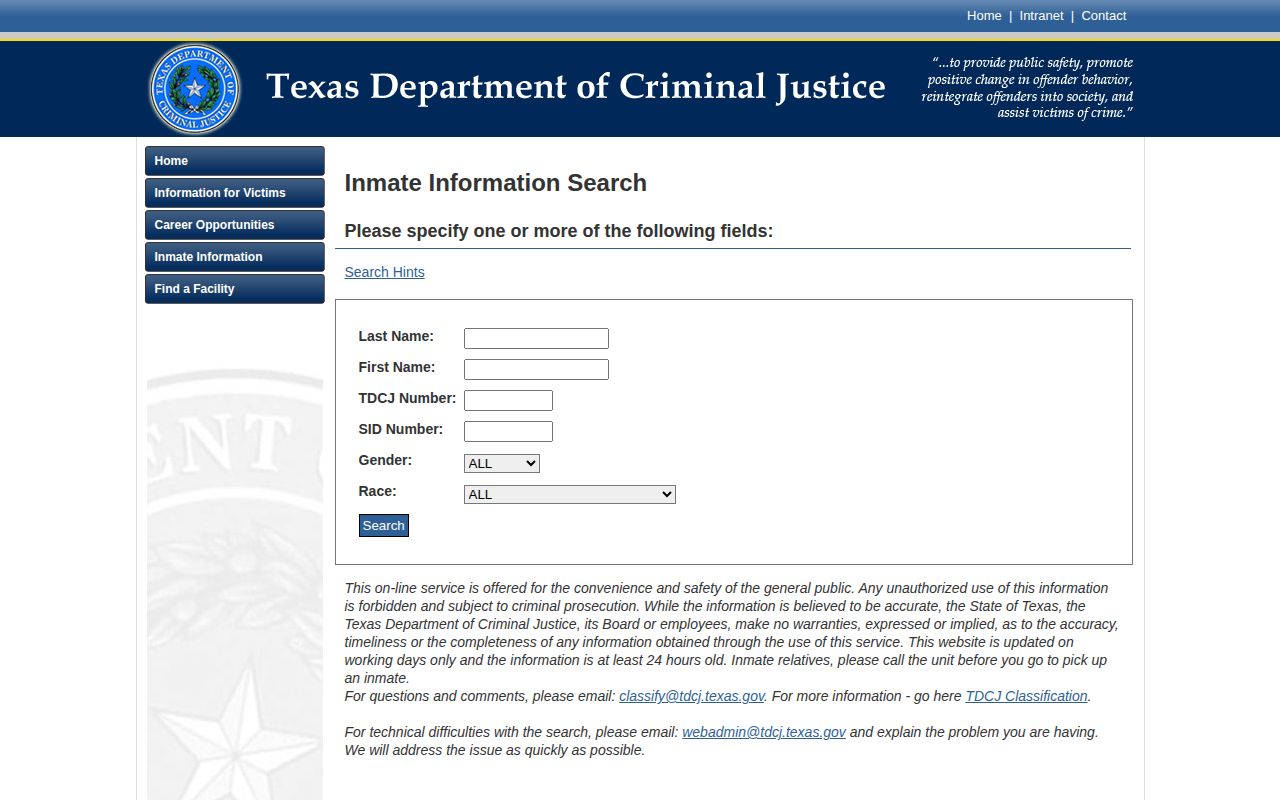
The official TDCJ search screen below displays the fields used to begin a state lookup.
Texas Has No Universal 85%
Texas cannot be reduced to a rule that every prisoner must serve 85 percent. Government Code Section 508.145 contains offense- and sentence-specific parole eligibility rules. For offenses and deadly-weapon findings within subsection (d), eligibility generally requires actual calendar time, without good-conduct time, equal to one-half the sentence or 30 calendar years, whichever is less, with a two-year minimum. Other subsections cover different offense and sentence classes.
Eligibility is still not release. A parole panel may deny release, require later review, or approve it subject to conditions and processing. Mandatory supervision also has exclusions and discretionary review under Sections 508.147 through 508.149. Older offense dates can invoke earlier law. The judgment, offense date, statutory category, and any deadly-weapon finding must be known before explaining the calculation.
Government Code Chapter 498 governs good-conduct time. Section 498.003 calls good time a privilege rather than a right. It may affect classification and release eligibility when governing law allows, but it does not shorten the court’s sentence itself. Disciplinary action can forfeit credits, and restoration is controlled by law and rule.
Note: Never import another state’s percentage shorthand into an Andrews County case; use the offense date, judgment, and Texas provision that actually applies.
Why Andrews County Dates Change
A projected date can move because its inputs or the legal route changes. Some events alter credit. Others stop release even when the sentence calculation reaches a date. TDCJ must audit the release certificate and check legal data, detainers, conditions, and calculations before an approved release occurs.
| Factor | Possible effect | Record to check |
|---|---|---|
| Good-time loss or restoration | Changes a permitted eligibility or projected calculation | TDCJ classification and discipline records |
| Detainer or hold | Can route the person to another authority | TDCJ and receiving-agency records |
| New or corrected judgment | Changes sentence data or credit | Certified court judgment or order |
| Stacked or concurrent sentences | Changes the controlling sentence sequence | Judgments and TDCJ time record |
| Board decision | Approves, denies, delays, or conditions parole | Official Board action and vote code |
| Program or residence condition | Can delay release after a favorable vote | TDCJ processing status |
Common approval codes also require care. FI-1 means release when eligible, FI-2 sets a specified future month and year, and other FI variants can require a program. RMS concerns mandatory-supervision release. None is an actual door timestamp. After a favorable vote, check processing, scheduled details, the release certificate, and supervision assignment.
TDCJ Release Processing in Andrews
A favorable Board action begins another stage. Classification and Records must receive and audit the certificate, confirm sentence data, review detainers, and satisfy any listed condition. TDCJ material says a common certificate audit may take about 14 to 21 business days. Some program-contingent cases may take roughly four to six weeks after successful program completion in the circumstances the agency describes. These are estimates, not promises for a named person.
Use the right status channel. Before a Board vote, the parole-review status line is 844-512-0461. After a favorable vote, parole-release processing status is 512-406-5202. Callers generally need a TDCJ or SID number, or an exact date of birth. These numbers answer different questions and should not be used as interchangeable release confirmations.
Once physical release occurs, an Andrews County assignment may route parole or mandatory supervision to Monahans DPO. That office assignment proves the supervision route, not final discharge. The state proof chain is Board action, scheduled processing, actual release certificate, field-office assignment, and later discharge.
Andrews County Jail Calculations
A county-jail sentence uses a different record set. Begin with the criminal judgment, sentence, jail credit, sheriff time computation, and any later court order. No official Andrews County good-time policy or weekend-advance policy was found. Do not apply TDCJ Chapter 498 rules to the county jail and do not promise release on the prior weekday.
For a pretrial booking, bond may permit release once all conditions and holds are cleared, but it does not create a fixed projected date. A dismissal or court order may end one basis for custody while another hold remains. Ask the sheriff whether the booking is closed, what release or transfer type applies, and which authority directed it.
A narrow records request can seek the commitment and release entries, jail-credit or time-computation record, release date and time, release reason, authority, destination, and the underlying order. The County Clerk handles misdemeanors. The District Clerk handles felony cases in the 109th Judicial District. Pair the jail record with the correct court file.
Confirm Andrews County Actual Release
A pending county custody change can be monitored through Texas IVSS-Counties. The sheriff still uses the older VINE label, but Texas moved the county workflow to IVSS. Registration may offer phone, text, email, or other live options. An alert can lag and may omit the destination, so it remains a notification rather than the release certificate.
The Andrews County VINELink inmate search explains the IVSS transition and registration steps. After an alert, contact the sheriff for a county event or TDCJ for a state event. Ask whether the departure was community release or transfer. A move to another jail, TDCJ, federal custody, or ICE is not freedom from custody.
For an older state record, request admission, release date, release type, certificate, discharge date, and supervising office through TDCJ’s public-information process. For an older county record, seek the permanent county jail-register entry and available booking-out documents. A durable record is more reliable than a vanished portal name.