
Andrews County Three-Day Release Window
Andrews County provides a generic Search Jail Records destination, not a page labeled as a 72-hour release list. The portal looped between default and login screens during the documented test. Its public result fields, update cadence, retention period, and any rolling-window controls could not be confirmed. It would be inaccurate to present that site as a working three-day feed.
A 72-hour inquiry still has value. It sets clear start and end timestamps for a telephone question or written request, spans three dates, and allows several custody events to be reconciled. It is especially useful when the last known contact occurred before a weekend. Yet the interval must be stated precisely because “the last three days” changes by the hour and may cross a date boundary.
Reconstruct Andrews County 72-Hour Releases
Use a fixed interval, such as noon on the first date through noon three days later. Then follow a channel chain that can survive the missing public list.
- Search the official county-linked jail portal for the named person and save any booking identifier or status.
- Call the Andrews County Sheriff’s Office at 432-523-5545. Ask whether the booking closed inside the interval and request the exact timestamp.
- Review Texas IVSS-Counties for a recent county custody event. The current Texas service replaced the older county VINE workflow.
- File a date-bounded request through the sheriff open-records form when a record copy is needed.
- Match the release reason and destination against the court or receiving-agency record.
The Andrews County 24-hour release check is better for a same-day event. For an older named-person search, begin at Andrews County released inmates and follow the custody-type route.
Andrews County Three-Day Record Fields
Because the online fields were not visible, ask the sheriff for the data needed to reconstruct the interval. Do not describe these as confirmed portal columns.
| Field | Use in a 72-hour review |
|---|---|
| Name, birth data, booking number | Separates matching names and ties each event to one booking. |
| Booking and release timestamps | Places the event within or outside the defined interval. |
| Release code and authority | Explains whether bond, time served, dismissal, or another order closed custody. |
| Destination | Shows community release or a transfer to continued custody. |
| Charges, court, case, bond, holds | Points to the controlling court record and unresolved restrictions. |
| Associated booking photograph | Helps reconcile identity when lawfully released by the sheriff. |
A release record is not a judgment of guilt. Bond is pretrial release, and dismissal must be established through the actual court order. Transfer to TDCJ, another county, a federal authority, or ICE means county custody ended while other custody continued.
Andrews County Weekend Release Timing
A weekend search may combine a bond decision, jail processing, a later data update, and an IVSS notice. Those are related but not identical times. Court action authorizes or affects release; jail staff still must clear holds and process the physical departure. A notification may follow the source event. Ask for the jail’s event timestamp rather than estimating from when a portal result disappeared.
The wider window also reduces the chance that a midnight boundary hides the event. Search name variants across all three dates, retain the booking number, and obtain the underlying order if the reason is unclear. Misdemeanor cases route through the Andrews County Clerk, while felony district cases route through the District Clerk and 109th District Court. The county court index warns that its entry is a guide; the filed document controls.
No Andrews County 72-Hour Feed
Phrase the written request as a time-bounded records question: seek all release events for the identified booking from the start timestamp through the end timestamp, including release time, type, authority, and destination. For one person, add full name, variants, date of birth if known, and approximate booking date. Ask for electronic copies, segregable public portions if something is withheld, and advance notice before costs pass a chosen amount.
The request travels through the sheriff’s official electronic form. Texas Government Code Chapter 552 supplies the public-information framework, though exceptions, redactions, and cost rules still apply. The public portal’s retention window is unknown, so an older event may persist only in agency records and the criminal case file.
Andrews Release Portal Limits
The official quick-links page is the safest entry because it keeps jail search, records requests, and notification together. The portal screenshot documents the tested landing state rather than proving that a recent-release list exists.
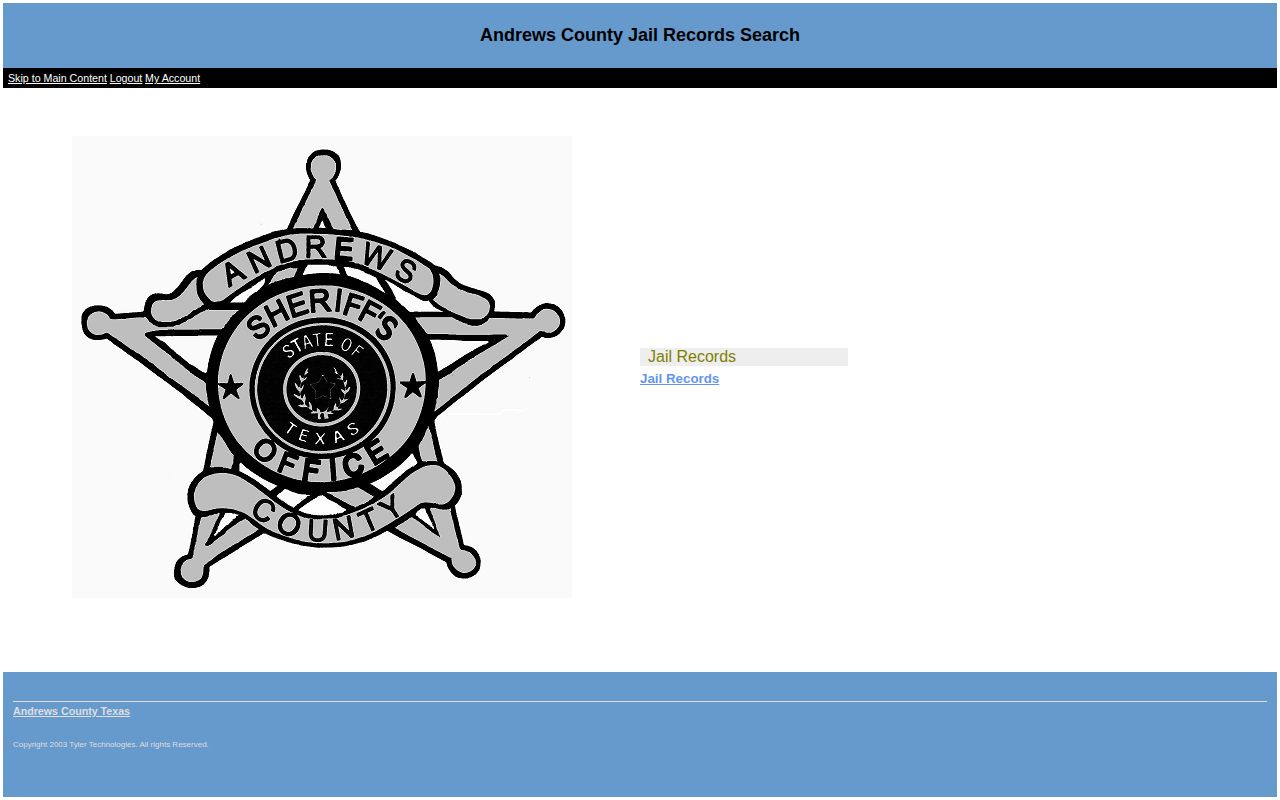
When the landing page loops or yields no matching record, move to sheriff contact and a date-bounded request. Silence on one screen cannot establish release, transfer, or discharge.
Where Andrews Releases Go Next
County custody can end in several ways. Bond, personal bond, time served, completion, dismissal, or another court order may return someone to the community. A destination of TDCJ, another county, BOP/USMS, or ICE requires a new custody check. Search TDCJ by its number or SID when available. Use BOP for sentenced federal prisoners, the federal docket for case status, and ICE ODLS plus ERO when immigration transfer is reported.
IVSS supplies county event and notification data, not a state-prison discharge certificate. TDCJ projected release and parole eligibility fields are not proof that departure occurred. Each system answers one phase of the person’s path, so the Andrews release line must be joined to the receiving record rather than read alone.
Preserve Andrews Three-Day Release Proof
A three-day review often produces several fragments: a portal result, an IVSS notice, a telephone answer, a release sheet, and a court entry. Record the source and access date for each fragment. Keep the booking number consistent across them. If dates conflict, ask the sheriff which timestamp records physical departure and whether a later entry was a correction. Notification systems can change their display, while the agency’s event record and filed court order provide a more durable trail.
For an older event, request the booking/release sheet and use the case number to locate the court file. Ask for a certified order when the legal reason matters. A “disposed” docket label does not show the time the jail door opened. Likewise, an IVSS alert can establish that a custody change was reported without identifying the precise destination. Combining the release entry, destination field, and court order answers three separate questions: when county custody ended, where the person went, and what legal action supported the change.
Retention for the Andrews public jail portal was not published in accessible official material. Texas local retention schedules provide general authority, but the schedule applied to the particular sheriff record must be confirmed with the records custodian. That is why a missing three-day web result should lead to a focused request, not a conclusion that no event occurred.
Use the date range with care when clocks or source labels differ. Ask whether the agency timestamp reflects release authorization, processing completion, or physical departure. If staff supplies only a date, request the time as a separate field. For a transfer, ask for the receiving agency rather than a precise destination address that may be restricted. The goal is to resolve custody accurately while limiting the request to information needed for the identified event.
Public Record Search
Sponsored Results