
Andrews County Parole Versus Probation
Texas assigns these forms of supervision to separate institutions. The Texas Board of Pardons and Paroles decides parole and mandatory-supervision matters within its authority. The TDCJ Parole Division then supervises a person who has left state prison under those terms. Andrews County probation is handled by the local Community Supervision and Corrections Department, commonly called CSCD. It serves adults under the county court and 109th Judicial District Court for misdemeanor, felony, pretrial-intervention, and bond-supervision matters.
Parole does not mean the sentence is complete. It means the person is outside prison while still under legal custody and set conditions. Mandatory supervision is also a supervised state release, although its eligibility and review rules differ. Probation follows a court order and can be imposed instead of incarceration. Someone reporting to Andrews CSCD may never have entered TDCJ. That fact alone cannot prove a state-prison release.
| Question | Parole or mandatory supervision | Probation or community supervision |
|---|---|---|
| Who orders or decides it? | Board action and Texas release law | County or district court order |
| Who supervises it locally? | TDCJ Parole Division through Monahans DPO | Andrews County CSCD |
| What came before? | Release from TDCJ custody | A criminal case; prison is not required |
| What proves completion? | Discharge or sentence-completion record | Court and CSCD completion records |
- Parole
- Conditional release from state prison before the sentence endpoint.
- Probation
- Court-ordered supervision in the community, also called community supervision in Texas.
- Discharge
- The documented end of the sentence or supervision described by the record.
- Absconder
- A person alleged to have stopped reporting or left supervision without approval. The term does not itself prove a new conviction.
Verify Andrews County Release Supervision
Start with the last known custodian. A person released from TDCJ should be matched in the official TDCJ inmate search by TDCJ number or SID number when available. Name-only matches need care. Compare the county of conviction, offense, sentence, and other identifiers. The result may show a projected date or parole eligibility date, but neither field proves actual release. A release certificate or current Parole Division assignment is stronger evidence.
For local probation, use the criminal case number and the Andrews County CSCD. The court docket establishes the order; CSCD can explain its lawful public contact route. No public county-wide probationer search or Andrews absconder list was found. A missing online record therefore does not prove supervision ended.
- Record the full name, date of birth, case number, and TDCJ or SID number if lawfully known.
- Decide whether the status began with a TDCJ release or a local court order.
- For parole, compare the TDCJ identity and status, then review Board decision information.
- Use the county-to-DPO assignment list to confirm the office serving Andrews.
- For probation, match the county or district court case and contact Andrews CSCD.
- Ask for the exact term used, office assignment, and proper records channel. Do not treat a favorable vote as an accomplished release.
Monahans Handles Andrews County Parole
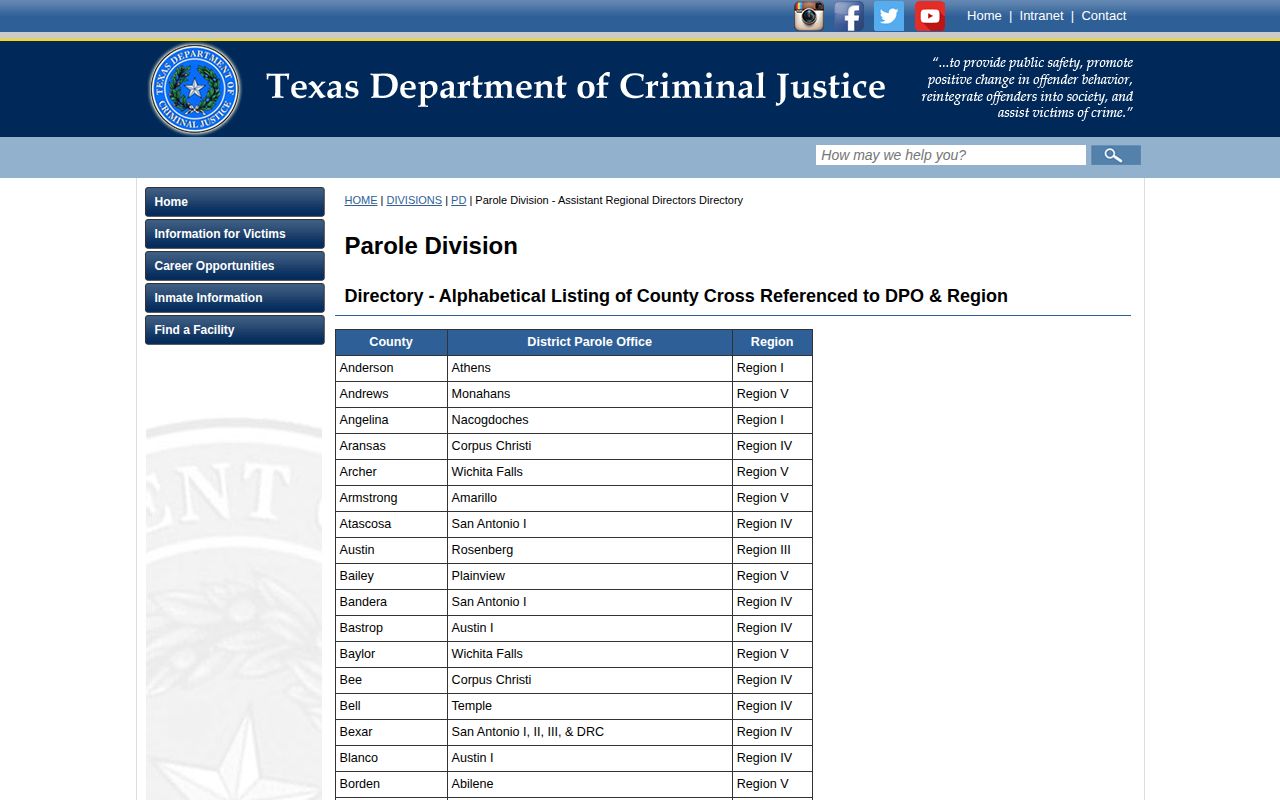
Andrews County residents on TDCJ parole or mandatory supervision are assigned to the Monahans District Parole Office. This office is part of TDCJ Parole Division and is not a jail. Its role begins after a qualifying state-prison release when the person is assigned to the Andrews area. The official Region V directory supplies the contact details.
401 S Allen Avenue
Monahans, TX 79756
Phone: 432-943-7254
Fax: 432-943-7397
Office assignment can help confirm that supervision continues, subject to privacy and identity limits. It does not replace the TDCJ release certificate or Board action. Those records answer different questions: the Board decision shows whether release was approved, TDCJ processing shows whether it was scheduled and completed, and Monahans DPO shows the field-office route after release.
The official Andrews-to-Monahans assignment is shown in the TDCJ county list. The image below captures that local mapping.
Andrews County Probation Office
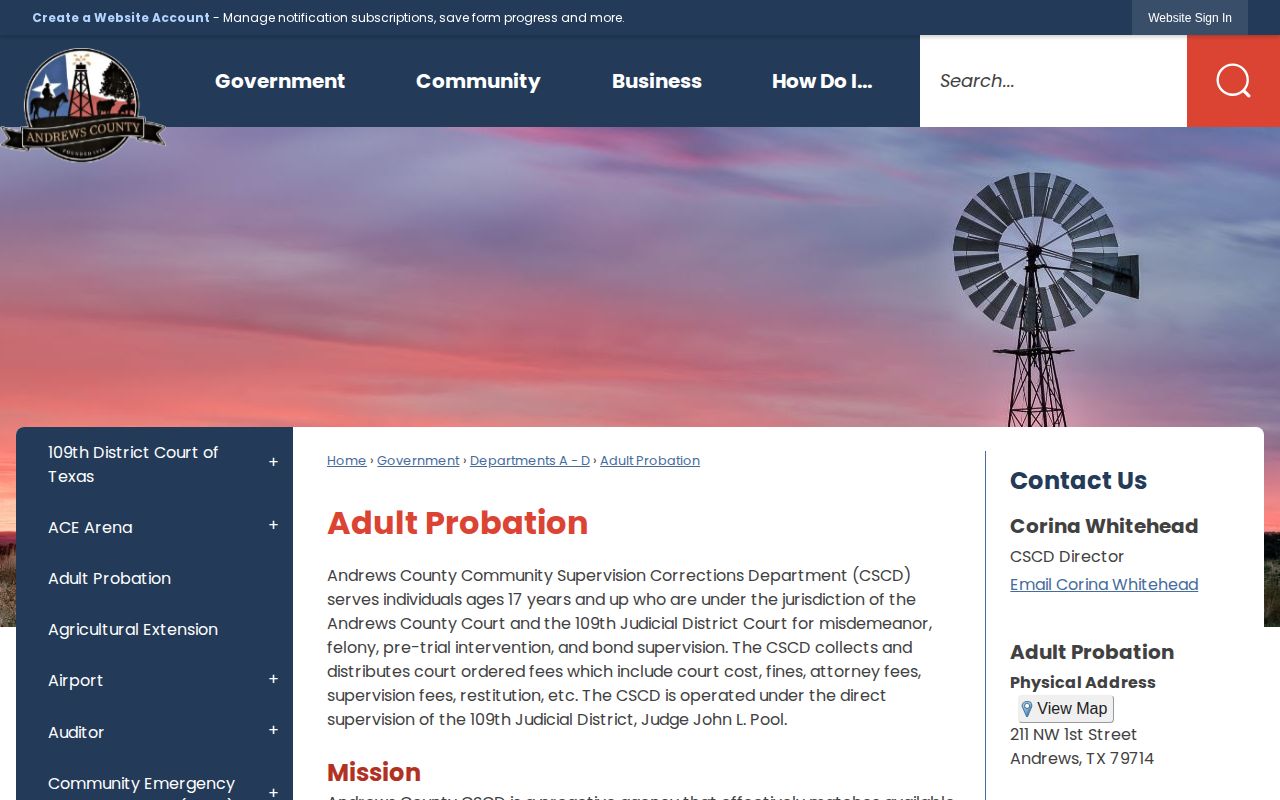
Andrews CSCD operates from 211 NW 1st Street and can be reached at 432-524-1416. Its official hours are Monday through Thursday from 7 a.m. to 5 p.m. and Friday from 8 a.m. to 5 p.m.; its page also states a later closing on the third Wednesday. The fax is 432-524-4014. These details belong to the probation office, not the sheriff’s jail and not Monahans DPO.
The CSCD scope includes misdemeanor and felony community supervision, pretrial intervention, and bond supervision for adults age 17 and older under the local courts. A person’s status should be tied to a case number and order. Office staff may limit what they disclose. Ask whether the supplied identity matches the office’s public record, what status term applies, and which clerk or records process holds the controlling document.
The official CSCD page visually confirms this local scope. Its page is the best starting point for current office information.
For the underlying case, the County Clerk handles misdemeanor matters while the District Clerk maintains felony cases in the 109th Judicial District. A docket can show the supervision order or later revocation, but it should be read with the agency record rather than used as a substitute for current status.
Andrews County Supervision Violations
Conditions depend on the order, certificate, and individual case. Common supervision topics can include reporting, travel approval, programs, financial obligations, or conduct rules, but no condition should be attributed to a named person without the controlling record. A violation allegation is not the same as a finding. A court handles probation revocation through its process, while TDCJ and the Board use parole warrant and revocation procedures for state supervision.
“Absconder,” “warrant,” and “revocation pending” describe distinct stages. An absconder label generally means the agency alleges the person stopped reporting or cannot be located as required. A warrant may authorize arrest. Revocation pending means the supervising authority has not necessarily made its final decision. None is ordinary discharge, and a warrant list is not a list of every person under parole or probation.
Texas county notification now uses IVSS-Counties for county custody events, while TDCJ Victim Services handles state-prison and parole notifications. Neither replaces direct verification with the responsible supervision office. When custody is the immediate question, use the current agency and obtain the warrant or revocation record through the proper process.
Note: A return to jail may stem from a new case, a supervision warrant, or another hold, so match the booking and issuing authority.
Local Andrews County Reentry Routing
No dedicated Andrews County reentry office was documented in the official-source review. The useful local route is therefore based on legal status, not a generic program list. A person on probation, pretrial intervention, or bond supervision starts with Andrews CSCD. A person released from TDCJ on parole or mandatory supervision uses Monahans DPO. Someone who has completed supervision may need a discharge record from the agency that held the case.
This routing also prevents missed reporting. Traveling to the Andrews courthouse does not substitute for reporting to a TDCJ field office in Monahans. Calling Monahans about a county probation order likewise reaches the wrong agency. When the status is unclear, first retrieve the release or court record and identify the supervising authority named there.
The distinction has a practical records value. Board approval, physical release, active supervision, and final discharge occur at different points. The Andrews County released-inmate search and records path explains how the jail, court, and state records fit together. Use that chain when a supervision record alone does not show how custody ended.
Ending Andrews County Supervision
Parole or mandatory supervision ends only when the governing sentence and supervision record show discharge or another lawful termination. Reaching a projected release date, receiving a favorable Board vote, or moving outside prison does not establish completion. TDCJ records may distinguish release on parole, release to mandatory supervision, maximum sentence, and discharge. Request the release certificate or discharge information when the web result is incomplete.
Probation ends through the court and CSCD case process. Completion may be reflected in an order or case entry. Revocation, extension, or an unresolved warrant can change the expected end. Obtain the actual document from the correct clerk rather than relying on a bare status label or a name-only index result.
Texas Government Code Chapter 508 governs parole and mandatory supervision. Texas Code of Criminal Procedure Chapter 42A governs community supervision. Those laws set frameworks, while the person’s judgment, release certificate, and agency status establish the specific result.