
Andrews Federal Release Route
No Federal Bureau of Prisons institution was identified in Andrews County. The facility name on this page therefore describes a nationwide custody system, not a jail building in Andrews. A person arrested locally on a federal matter may be held by the U.S. Marshals Service in a county or contract bed before trial. USMS manages federal pretrial detention and movement. BOP generally takes responsibility after a federal court commits a sentenced person to its custody.
The distinction controls the search. An Andrews County Jail booking-out entry may show transfer to a federal authority. That event is not proof of release to the community, and it is not proof of BOP admission. Match the county destination entry with the federal docket and the receiving agency. The official Andrews County sheriff page identifies the local jail access routes, and the county sheriff directory supplies the current jail contact. For the local method, the Andrews County released-inmate search and records path explains how to request the release or transfer entry.
A transfer from Andrews County custody to USMS or BOP continues custody. Call it a transfer until the federal record confirms release.
Search BOP Released Records
The official BOP Inmate Locator is the starting point for a sentenced federal prisoner. Its records generally cover federal inmates from 1982 onward. Search by BOP register number when available because an agency identifier sharply reduces confusion. The locator also offers a name-based search with age, race, and sex fields. Compare all visible identifiers rather than accepting a name match.
- Choose the number search when the BOP register number is known. Otherwise enter the full name and narrow the result with lawful biographical details.
- Open the matching record and note the register number, reported location or status, and release date.
- Compare that result with the federal criminal judgment and later docket entries. A future date remains a projection.
- If the record lacks needed detail, use BOP FOIA with the required identity or authorization documents.
The BOP locator record guide explains the database's coverage and limits. It is vital for older cases and unusual status words.
Reading Federal Release Results
BOP terminology answers only the federal-prison question. A past release date and a released location or status mean the person is no longer in BOP custody as that agency reports it. “Not in BOP Custody” has the same narrow boundary. Neither phrase rules out federal supervised release, state custody, a local jail, immigration custody, or another legal obligation.
| BOP result | Careful interpretation |
|---|---|
| Released with past date | BOP reports that its custody ended on the listed date; confirm later obligations in the docket. |
| Future release date | A projected federal date that may change after sentence-credit or legal updates. |
| Unknown | The term or release point is not determined in the locator data. |
| In transit | The person is moving within federal custody, not released. |
| Not in BOP custody | No current BOP custody is reported; it is not a universal custody search. |
BOP says its locator data are extracted daily. Recent court action can still precede the next visible change, and sentence-credit recalculations may affect a future date. Preserve the result date, then verify a recent event from the docket or agency record.
Federal Release Record Sources
A locator result is a useful lead, but it is not the entire release file. The federal judgment states the sentence. Later docket entries can address sentence changes and supervised release. PACER's federal case locator provides the docket route, subject to access fees and sealed-record rules. Do not substitute the estimated date shown in an old judgment for the actual BOP release event.
For agency documents, use the BOP Freedom of Information Act process. A narrow request should identify the person by name and register number and specify the existing record sought, such as release date, release location, custody history, or releasable portion of the release documentation. Privacy rules and identity requirements can limit what a third party receives. For imprisonment before 1982, the National Archives may be the proper historical custodian.
If Andrews County physically held the person before federal transfer, use the sheriff's electronic open-records form for the local booking-out and destination entry. That county document does not replace BOP or USMS records, but it establishes the handoff point and the agency named by the jail.
- Release date
- The date BOP reports that federal prison custody ended.
- Supervised release
- A court-ordered period in the community after incarceration, administered through the federal probation system.
- Federal detainer
- A request or notice tied to another agency's custody; it does not itself establish BOP imprisonment.
- FOIA
- The federal process for requesting existing agency records, subject to exemptions and privacy safeguards.
USMS Versus BOP Custody
The U.S. Marshals Service prisoner-operations description places federal pretrial detention and prisoner movement with USMS. That agency contracts with state and local facilities. Physical presence at Andrews County Jail can therefore coexist with federal custody responsibility, but the BOP locator may have no record because the person was never a sentenced BOP prisoner.
| Stage | Likely record owner | Best confirmation |
|---|---|---|
| County arrest or county case | Andrews County Sheriff and local court | Booking-out entry and court order |
| Federal pretrial detention | USMS and federal court | Federal docket, physical jail record, USMS records |
| Federal prison sentence | BOP | BOP locator, judgment, BOP record |
| After prison | Federal court and probation office | Docket and supervising-office record |
USMS has no public historical name locator comparable to BOP's. When the federal docket shows pretrial release or acquittal, pair that judicial event with the physical jail's booking-out record if the exact custody end matters.
Federal Status After Prison Release
Release from a BOP institution does not necessarily end the federal sentence structure. A federal judgment may impose supervised release after imprisonment. The person is outside BOP prison custody, but the federal court and probation office can still maintain supervision records. The BOP locator's released status should therefore be quoted as the end of BOP custody, not as proof that every federal condition has ended.
Read the judgment and later docket entries for the term of supervised release, modifications, alleged violations, revocation proceedings, and an order ending supervision. A later arrest or revocation can create a new custody event that does not change what the older locator entry meant on its own date. For a named person, preserve the case number and distinguish the original incarceration, the BOP release, community supervision, and any return to custody.
Sentence-credit changes also require care. A future BOP date can move after recalculation, and the locator may carry a notice about that work. A past date with a released label is stronger than a future projection, but the federal docket remains important when a court has amended the judgment or addressed supervision. Do not convert the word released into discharged unless an official record supports completion of the applicable federal obligation.
Federal court access can involve fees, and sealed documents are not available merely because the person once appeared in BOP. Request only the record needed to confirm custody or release. When privacy rules restrict an agency response, use the public locator and public docket without trying to infer hidden facts from an omission.
Verify Andrews Federal Release
A reliable conclusion uses a short chain of records. Begin with the last known custodian and the case number. If Andrews County booked the person, ask whether the local event was community release or transfer. If USMS took custody, use the docket to identify detention and release orders. If BOP later received the person, use the locator and BOP records for the prison phase. Finally, read supervised-release entries separately from incarceration.
A name-only match needs more support. Compare the BOP register number, age, race, sex, federal case number, sentencing court, and dates that can lawfully be checked. If the locator says released, compare its date with the docket and ask BOP for the releasable historical record when a precise event matters. A federal judgment states the sentence, but later credit calculations or amended orders can alter the custody timeline. The actual agency result should control over a date estimated from the original judgment.
Older federal cases require another route. BOP's public locator begins with 1982 records, so the absence of an earlier prisoner is expected and says nothing about release. The National Archives may hold a pre-1982 institutional file. A focused archival request should give the person's name, approximate birth date or age, race, and approximate confinement dates. For a more recent case, use BOP FOIA and follow its identity or authorization rules rather than treating a blank public search as the final answer.
The official BOP search screen shows the identifiers used for that nationwide check.
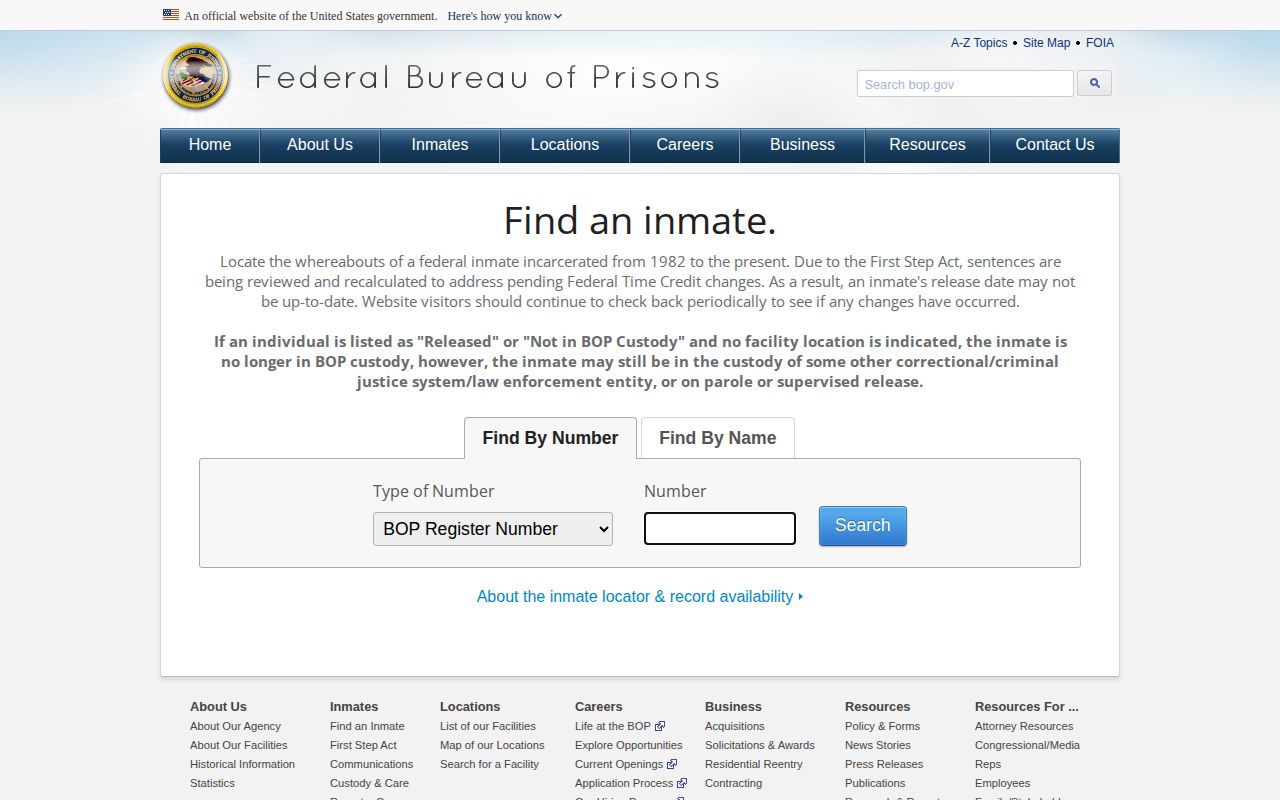
The screen does not search Andrews County jail files, immigration custody, or state-prison records. Move to the custodian shown by the transfer or judgment instead of forcing every case through one locator.
Note: A negative federal locator result never proves that a person was released from every custody system.